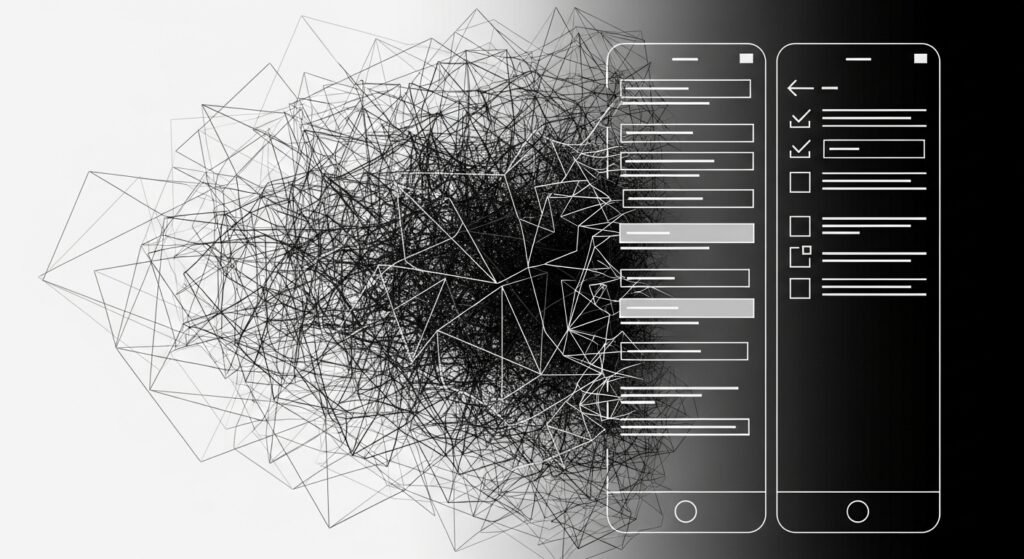
Most websites don’t fail because of lack of traffic.
They fail because of confusion.
Confusing layouts, unclear messages, overloaded pages and clever ideas that nobody understands are far more damaging than low traffic numbers. You can buy traffic. You can’t buy clarity.
After working with websites across different industries, one pattern repeats itself:
when users don’t understand what’s going on, they don’t move forward.
They don’t scroll, they don’t click, and they definitely don’t convert.
This is not a design problem.
It’s not an SEO problem.
And it’s not a copy problem.
It’s a clarity problem.
The real reason websites don’t convert
When people talk about conversion issues, the conversation usually goes in predictable directions:
- “We need better copy”
- “The CTA isn’t strong enough”
- “We need more traffic”
- “The design needs to look more premium”
In reality, most conversion problems happen before any of that matters.
Users land on a page and immediately face unanswered questions:
- What is this?
- Is this for me?
- What am I supposed to do here?
- Why should I trust this?
If those questions aren’t answered quickly and clearly, everything else becomes irrelevant.
No amount of persuasive copy can compensate for confusion.
No animation can fix a broken message.
No SEO strategy can save a page users don’t understand.
Conversion doesn’t fail at the button.
It fails at the first moment of interpretation.
When creativity becomes noise
Creativity is not the enemy.
Unfocused creativity is.
Many websites confuse being creative with being effective. They prioritize originality over comprehension, visual impact over hierarchy, cleverness over clarity.
The result is often impressive at first glance and frustrating seconds later.
- Headlines that sound smart but say nothing
- Layouts that look dynamic but don’t guide the eye
- Copy that entertains instead of explaining
- Interfaces that assume too much from the user
Creativity without structure becomes noise. And noise increases cognitive load.
When users have to figure things out, they leave.
Good design doesn’t ask users to think.
It helps them move.
Clarity as a competitive advantage
Clarity is boring until it starts winning.
In crowded markets, most competitors are fighting for attention with louder visuals, more features and more words. Very few compete on understandability.
That’s where clarity becomes a real advantage.
A clear website:
- Reduces friction
- Builds trust faster
- Makes decisions feel easy
- Scales better over time
Clarity doesn’t mean minimalism.
It doesn’t mean removing personality.
It means making the path obvious.
When users know where they are, what you offer and what to do next, conversion becomes a natural outcome, not a forced one.
Design, SEO and copy are the same problem
These disciplines are often treated as separate silos:
- Design focuses on visuals
- SEO focuses on keywords
- Copy focuses on persuasion
In reality, they are solving the same problem from different angles:
helping users understand information.
SEO is about structuring information so it’s discoverable.
Design is about structuring information so it’s usable.
Copy is about structuring information so it’s meaningful.
When they don’t align, the site breaks.
You get:
- Pages optimized for keywords but unreadable
- Beautiful interfaces that don’t explain anything
- Copy that persuades nobody because the context is missing
Clarity happens when structure comes first, and everything else supports it.
What clarity actually looks like in practice
Clarity is not abstract. It’s visible.
It shows up in decisions like:
- Clear page hierarchy instead of equal visual weight everywhere
- Headlines that explain, not tease
- Sections that answer one question at a time
- Navigation that reflects how people think, not how teams are organized
- Copy that guides instead of convinces
Clear websites don’t try to impress immediately.
They try to be understood.
Ironically, that’s what ends up being impressive.
Why most websites fail
Most websites don’t fail because they lack talent.
They fail because too many decisions are made in isolation.
Design decisions without SEO thinking.
SEO decisions without UX thinking.
Copy decisions without structural thinking.
Clarity requires integration.
It requires saying no to unnecessary ideas.
It requires prioritizing the user’s understanding over creative ego.
That’s hard.
But it’s also what works.
Final thought
Creativity gets attention.
Clarity gets results.
If a website doesn’t work, the problem is rarely that it’s not creative enough.
It’s usually that it’s trying too hard to be everything at once.
The clearer the message, the clearer the path.
And the clearer the path, the higher the conversion.
Related topics
- UI/UX Design focused on structure and hierarchy
- SEO built around information architecture
- Conversion driven by message clarity