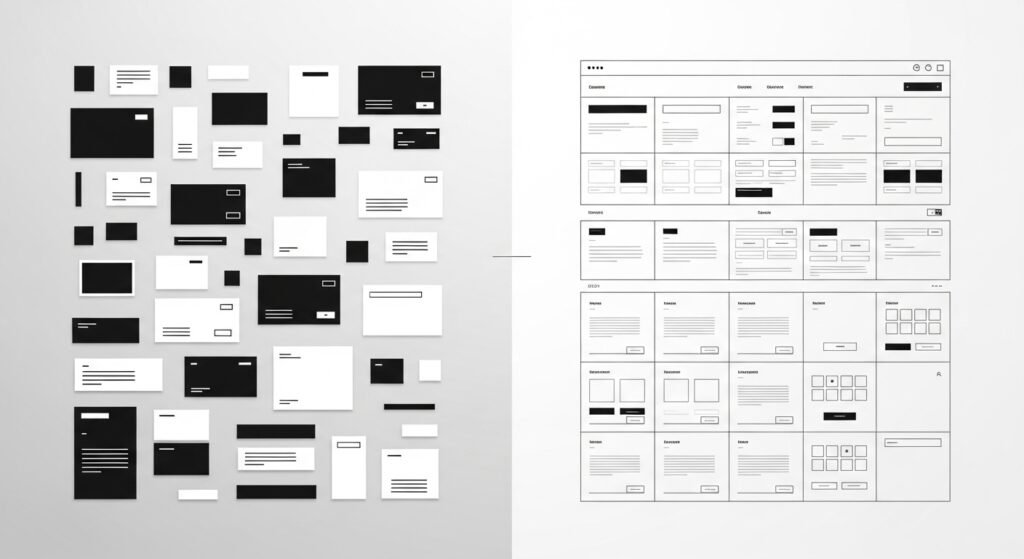
They fail because too many decisions are made in isolation.
Design teams chase originality.
SEO teams chase visibility.
Marketing teams chase persuasion.
Each discipline optimizes for its own goals — and the website breaks in the gaps between them.
This is not a skill problem.
It’s a coordination problem.
And it’s the reason why most websites feel loud, confusing and ineffective despite being built by competent people.
The myth of “good enough” execution
Most websites are not badly executed.
They are locally optimized.
Each part works on its own:
- The design looks polished
- The content is well written
- The SEO checklist is complete
But the system as a whole doesn’t work.
Users don’t experience websites as layers. They experience them as flows. When those flows are fragmented, users stall.
This is why clarity beats individual excellence.
As explained in
Clarity beats creativity: why most websites fail
A site can be creative, optimized and persuasive — and still fail — if those qualities don’t align.
When creativity becomes noise
Creativity is not the problem.
Unconstrained creativity is.
Many interfaces prioritize being interesting over being understandable. They tease instead of explain. They animate instead of guide. They reward novelty instead of predictability.
The result is visual noise.
Noise increases cognitive load.
Cognitive load slows decisions.
Slow decisions kill conversion.
This is why
UI/UX design is about decisions, not aesthetics
Design decisions are not artistic choices. They are behavioral constraints.
SEO suffers from the same fragmentation
SEO is often treated as a layer added after design and content decisions are already locked.
Keywords are inserted. Metadata is optimized. Technical issues are patched.
But the core problem remains: the page still doesn’t explain itself.
Search engines don’t reward pages that merely contain information. They reward pages that resolve intent.
That’s why
SEO is about being understood, not ranking
When meaning is unclear to users, it is eventually unclear to search engines as well.
Persuasion without clarity creates resistance
Marketing often tries to compensate for structural confusion with stronger persuasion.
More urgency.
More benefits.
More emotional triggers.
But persuasion applied too early feels manipulative, not convincing.
Users don’t resist because they are skeptical.
They resist because they are disoriented.
This is why
conversion happens before persuasion
Clarity prepares the ground. Persuasion only works once the context is set.
The real problem: decisions made in silos
Most websites are built through handoffs.
Design → Content → SEO → Marketing
Each step inherits constraints it didn’t choose. Each team optimizes locally. No one owns the system as a whole.
The outcome is predictable:
- Pages that look good but don’t explain
- Content that ranks but doesn’t convert
- Copy that persuades without context
Users don’t care which team made which decision. They only feel the friction.
What actually works: structural thinking
Websites that work consistently share one trait:
structure comes first.
Before visuals.
Before keywords.
Before persuasion.
Structure answers:
- What is this?
- Who is it for?
- How does it work?
- What happens next?
Everything else supports those answers.
This is why design, SEO and copy are not separate disciplines. They are different expressions of the same structural problem.
Why trends keep failing in real projects
Trends optimize for screenshots, not systems.
They perform well in isolation — landing pages, showcases, portfolios — but break when exposed to:
- real content
- real constraints
- real users
Good systems age well.
Trends expire quickly.
That’s why editorial clarity outperforms visual novelty over time.
Final thought: websites fail between disciplines
Most websites don’t fail because people don’t know what they’re doing.
They fail because no one is responsible for how decisions connect.
Clarity is not a deliverable.
It’s an outcome of alignment.
When structure leads, everything else falls into place:
- SEO becomes interpretable
- UI/UX becomes invisible
- Conversion becomes natural
Until then, websites will keep looking good — and quietly underperforming.